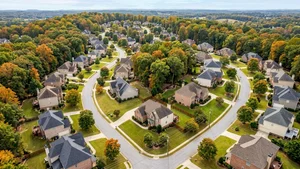
Forsyth County sits about 40 miles north of Atlanta, transitioning over the decades from rural farmland into a major suburban housing market. The history of Forsyth County, GA, is marked by both rapid modern development and periods of deep racial conflict that shaped its population for generations. Buyers looking at homes here today see a landscape of large subdivisions, well-regarded schools, and commercial centers.
Understanding how this area evolved provides helpful context for anyone moving to the region. The county's real estate market shifted dramatically with the construction of major infrastructure projects in the mid-20th century. Today, the area balances its agricultural past with modern amenities, drawing new residents from across the country.
The 1832 Founding and Early Agricultural Economy
The state legislature established the county in December 1832, carving the boundaries out of former Cherokee territory. Lawmakers named the new jurisdiction after John Forsyth, a prominent politician and Governor of Georgia. The city of Cumming was soon designated as the county seat, serving as the central hub for local government and commerce.
For more than a century, the local economy relied on agriculture. Farmers primarily grew cotton, utilizing the fertile soil of North Georgia to support their households. The land was dotted with small farms and agricultural tracts long before the arrival of paved highways and planned subdivisions.
The 1912 Expulsion and Demographic Shift
In the early 20th century, the county's trajectory changed following a series of violent events. In 1912, after a white woman named Mae Crow was assaulted and murdered, a white mob lynched a Black man named Rob Edwards in the Cumming town square. Night riders and armed groups then began a systematic campaign of terror against Black families across the county.
Over 1,000 Black residents were forced to leave Forsyth County under threat of violence, abandoning their homes, farms, and Black churches. This racial cleansing turned the area into an all-white sundown county for decades. United States Census Bureau records show the Black population dropped to nearly zero and remained there through most of the 20th century.
The 1987 Brotherhood March and National Response
The county's exclusionary history drew national media attention in early 1987. Civil rights leader Hosea Williams organized a Brotherhood March to protest the ongoing absence of Black residents and the legacy of the 1912 expulsion. The initial march was met with violent counter-protests from the Ku Klux Klan and other white supremacist groups who threw rocks at the demonstrators.
A second march took place shortly after, drawing roughly 20,000 civil rights supporters to the city of Cumming. The events prompted Oprah Winfrey to broadcast an episode of her talk show directly from the county, interviewing white residents about the area's racial climate. This national spotlight forced local leaders to begin addressing the area's long-standing reputation.
The Creation of Lake Lanier and Waterfront Housing
The local housing market experienced a major shift in the 1950s when the federal government dammed the Chattahoochee River. This massive engineering project created Lake Lanier, which was officially completed in 1956. The lake flooded thousands of acres of former farmland and fundamentally altered the region's topography.
With the introduction of hundreds of miles of shoreline, waterfront properties entered the local real estate market for the first time. Buyers began purchasing lots for vacation homes, private docks, and recreational access. The local economy gradually transitioned away from pure agriculture toward recreation, tourism, and residential development.
Highway 400 and the Suburban Expansion
The expansion of Georgia State Route 400 served as the primary catalyst for the county's modern population boom. Before the highway reached the area, the drive to Atlanta was a long, rural route that discouraged daily commuters. The new interstate-grade road connected Cumming directly to Fulton County and the broader Metro Atlanta job market.
Commuting times dropped, allowing professionals to work in the city while buying larger, more affordable homes further north. Developers responded by converting remaining rural land into large suburban housing tracts. This infrastructure upgrade transformed the county from an isolated rural enclave into a major suburban destination.
Historical Landmarks and Protected Green Spaces
Modern residential neighborhoods often sit within a short drive of the county's historical and natural landmarks. The local government has preserved several large tracts of land to maintain green space amid the rapid suburban expansion. Buyers often look for properties near these public amenities.
The county maintains several key sites that highlight both its natural environment and local history:
Sawnee Mountain Preserve: This 963-acre space offers hiking trails, an interactive visitor center, and views of the Blue Ridge Mountains.
Big Creek Greenway: A concrete and boardwalk trail system winding through the woods, frequently used by cyclists and pedestrians.
Cumming Playhouse: Located in the historic 1923 public school building, this venue hosts theatrical performances and community events.
Current Housing Trends and Census Data
By 2026, the county's population has grown to approximately 286,000 residents, reflecting decades of continuous inbound migration. The demographics have shifted considerably from the late 20th century. United States Census Bureau data shows a growing diversity among residents, with Asian and Indian residents making up roughly 20% to 23% of the population, alongside a growing Latino community.
The 2026 real estate market features a median home price between $620,000 and $674,000, depending on the specific zip code and property type. The inventory includes a mix of older historic properties near the county seat and new construction developments further out. Many buyers focus their search here to access the Forsyth County Schools system, which consistently posts high enrollment numbers and graduation rates.
Frequently Asked Questions
What happened in Forsyth County in 1912?
In 1912, white mobs forced the entire Black population of over 1,000 people to leave the county following the lynching of Rob Edwards. Night riders burned Black churches and homes, turning the area into an all-white jurisdiction for decades. The demographic impact of this racial cleansing lasted until the late 20th century.
How did Lake Lanier affect Forsyth County real estate?
The completion of Lake Lanier in 1956 introduced miles of shoreline to a previously landlocked agricultural area. This created a new market for waterfront homes, private docks, and vacation properties. The lake shifted the local economy toward recreation and spurred early residential development.
What are the current demographics of Forsyth County, GA?
As of 2026, the county holds about 286,000 residents and has grown increasingly diverse. Census data indicates that Asian and South Asian residents now make up roughly 20% to 23% of the population. The area also hosts a growing Latino community, reflecting broader migration trends across Metro Atlanta.