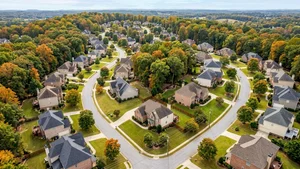
If you're looking at homes in Fulton County, safety and livability are probably near the top of your list when weighing the pros and cons of living in Alpharetta, GA. Alpharetta draws buyers consistently - the employment centers are strong, the amenities are real, and the housing market stays active for good reason.
The numbers reflect that demand. As of mid-2026, the median sale price sits around $785,000, and homes are spending roughly 24 days on the market. With about 4.4 months of supply, this isn't a place where you'll have time to be casual about an offer. That's exactly why it helps to understand the public safety picture, the environmental factors, and what daily life actually looks like before you're writing checks.
Examining the Crime Data for Alpharetta, GA
Town-level crime statistics tell you more than neighborhood gossip ever will. NeighborhoodScout reports an overall crime rate of about 14 crimes per 1,000 residents in Alpharetta - that works out to roughly a 1 in 69 chance of experiencing either violent or property crime.
That puts the city's rate higher than 68% of Georgia towns, but lower than many similarly sized U.S. cities. The underlying figures are the 2024 calendar-year FBI data released in October 2025. State context matters here, so it's worth looking at how Alpharetta stacks up against Georgia as a whole.
State and National Comparisons
Georgia's statewide violent crime rate averages about 325.7 incidents per 100,000 people. The state's property crime rate runs roughly 1,674.9 per 100,000 people.
Alpharetta's property crime rate comes in well below both those benchmarks. AreaVibes and HomeSnacks report the local property crime rate at 1,152.1 per 100,000 people - 781 total incidents - which places the town about 31% to 34% below both the Georgia and national property crime averages. That's a meaningful gap.
Recent Crime Rates and Multi-Year Trends
Breaking down crime by type gives you a clearer read than a single headline figure. Violent crime here runs low relative to property crime, and the specific numbers shift a bit depending on which reporting agency you're looking at and which year.
NeighborhoodScout puts the violent crime rate at roughly 3 per 1,000 residents, or a 1 in 380 chance. A 2024 FBI-based figure cited by CrimeGrade and AreaVibes shows about 275 violent crimes per 100,000 people - 183 total incidents, with zero murders reported that year.
How Rates Have Trended Recently
The direction of travel here is positive. According to City-Data, the Alpharetta crime index fell by 10% in 2025 compared to 2024.
Pull back further and the picture holds. Over the last five years, the city has seen a steady decrease in both violent and property crime. That kind of multi-year consistency matters more than any single data point.
Emergency Services and Public Safety
The Alpharetta Department of Public Safety handles police, fire, and emergency medical response under one roof. That unified structure lets the city coordinate resources across its various districts without the friction that comes from separate agencies operating independently.
Staffing has fluctuated slightly in recent years but remains solid. As of May 2026, the department carries about 120 sworn officers, with 12 sworn vacancies currently open.
Department Staffing Trends
Earlier figures from City-Data show the department had 105 officers in 2025 out of 159 total law enforcement employees - a slight dip from 113 officers in 2024 and 134 in 2023.
The city has been actively recruiting to close that gap, including offering signing bonuses to incoming officers. It's not a department treading water - they're working to get back to full strength.
Environmental Hazards and Water Quality
Crime data is only part of the picture. Environmental factors belong in the conversation too, and Alpharetta has a few worth knowing about before you buy.
Flooding is the most common natural risk in the area. The City of Alpharetta notes that flash floods can occur anywhere in town, particularly where local streams and creeks rise quickly out of their banks during heavy rain. That's worth checking against any specific property you're seriously considering.
Lake Windward Guidelines
Lake Windward is a prominent local feature, but it's not a public amenity. It's a private, HOA-managed body of water with access restricted exclusively to Windward homeowners and their guests. The lake is used primarily for boating, kayaking, and catch-and-release fishing - not swimming.
The Windward Community Services Association monitors water quality and maintains fish habitats through an accredited aquatic management service. Swimming is handled separately through the community's Windward Swim Center and Racket Social Club facilities.
Wildfire Risk Profile
Wildfire is not a serious concern here. Data from Wildfire Risk to Communities places homes and buildings in Alpharetta predominantly in the "Minimal Exposure Zone," which means properties are unlikely to face wildfire threats. It's not something most buyers in this area will need to plan around.
What It Is Like to Live in Alpharetta
Day-to-day life in Alpharetta runs on a mix of parks, walkable commercial areas, and straightforward highway access. The market backs that up - as of mid-2026, there are 331 available homes ranging from townhomes to large single-family properties, which gives buyers real range to work with.
The area's layout is practical. Suburban space, solid commercial conveniences, and access to Atlanta without living inside it - that combination is what keeps buyers coming back to this part of Fulton County.
Recreation and Commuting
Green space and community programming are woven into the city's layout. The Alpha Loop is a standout example - it creates walkable pedestrian connections between different parts of the city, which isn't something you find in every suburb at this price point.
For commuters, access to Atlanta via major highways is direct. That matters for anyone working across the broader Fulton County area who wants suburban space without a complicated drive.
Housing Costs and Market Pacing
The market moves fast. Homes sell in roughly 24 days on average, and nearly 26% of properties sell above list price. If you find something you like, deliberating for a week usually isn't an option.
For more detail on what it costs to live here day to day, or how educational zoning works in this area, our cost-of-living and school district guides are worth a read before you start touring.
Frequently Asked Questions
How does the crime rate in Alpharetta, GA compare to other North Atlanta suburbs?
Alpharetta's property crime rate sits about 31% to 34% below the Georgia state average, and the city's overall crime rate runs about 14 incidents per 1,000 residents. Direct comparisons to specific neighboring North Atlanta suburbs depend on the town in question, but Alpharetta generally comes in below the broader state average.
What are the safest neighborhoods to buy a house in Alpharetta?
Publicly available crime data for Alpharetta is reported at the town level - not broken out by individual neighborhood. The Alpharetta Department of Public Safety provides uniform police, fire, and EMS coverage across the entire municipality. Your best move is to focus on the amenities, home styles, and commuting routes that fit your situation.
What types of property crime should new Alpharetta homeowners be aware of?
The most recent dataset shows 781 total reported property crime incidents in Alpharetta, at a rate of 1,152.1 per 100,000 people. That's lower than Georgia's statewide rate of 1,674.9 per 100,000. Over the last five years, the city has seen a consistent decline in overall property crime.
Is it safe to walk around Downtown Alpharetta and the Avalon area at night?
The Alpharetta Department of Public Safety patrols all commercial and residential areas, including downtown and local shopping districts. As of May 2026, the department employs about 120 sworn officers to maintain that coverage. The city's violent crime rate sits at roughly 3 incidents per 1,000 residents annually.
Where can prospective buyers find official crime maps and police reports for specific Alpharetta addresses?
For aggregated town-level statistics, NeighborhoodScout, CrimeGrade, and AreaVibes are solid starting points. For specific incident reports, the Alpharetta Department of Public Safety maintains public records. CrimeMapping.com is also a useful tool for looking at recent local data by address.
How safe are the public schools for families relocating to the Alpharetta area?
School safety data and security protocols are managed directly by the local school district. Prospective buyers should contact the district administration or check the official website to review campus security measures. The city's overall violent crime index has decreased over the last five years, which speaks to the broader environment these institutions operate in.