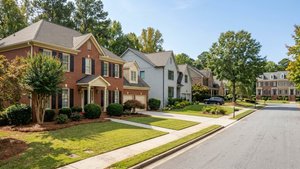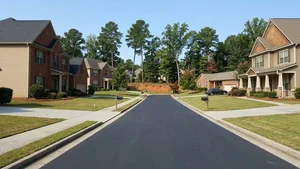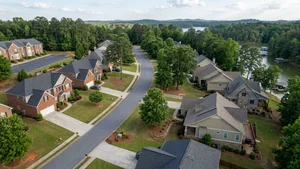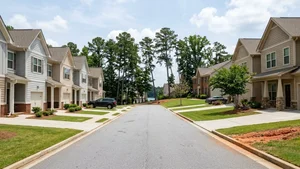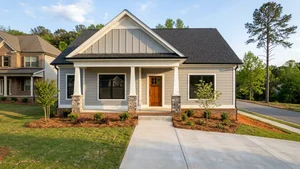
The median home price in Alpharetta, GA, sits at roughly $750,000, showing zero year-over-year growth.
Key takeaway
Alpharetta's forecast splits by home type. Detached houses look set to stay firm. Townhouses, with falling prices and the deepest supply in the city, are where buyers should expect room to negotiate. If you need a detached house, plan on less bargaining power; if a townhouse fits your needs, the coming months work in your favor.
Who this guide is for
You are weighing whether to buy or sell a home in Alpharetta within the next 12 months, and you need to decide whether to act now or wait, and how hard to negotiate.
Alpharetta housing market forecast for the next 12 months
Alpharetta's citywide median is flat at 0% year over year, but that figure is two opposite forecasts averaged together. Detached houses, with about 4.1 months of supply, look set to hold their value. Townhouses sit at a heavier 7.5 months of supply, making them the segment most likely to keep softening.
For the bigger picture, see Alpharetta Housing Market.
This forecast comes from leading indicators like supply, time on market and sale-to-list ratios, rather than direct price predictions. Months of supply measures how long it would take to sell current inventory at the current sales pace. Housing economists generally consider a five- to six-month supply to be a balanced market: under five months favors sellers, over six months favors buyers.
Which forecast applies to you
If you need a detached house, read the single-family section and expect little room to bargain. If you're flexible, start with the townhouse section, where supply is deepest. If you're selling a detached house and buying a townhouse, the forecast is on your side at both ends of the transaction.
If you might need to resell within a few years, read the catch at the end of the townhouse and condo sections before committing. If your budget changes based on where mortgage rates go, review the rate outlook before deciding to wait out the market.
Where prices are firm and where buyers have room to negotiate
With a detached house, you pay more and have less bargaining power. With a townhouse, you pay more per square foot but can negotiate harder. Condos are a small, slow segment.
Single-family homes hold the firmest ground
Detached houses are the tightest segment in the city and the most likely to hold value over the next 12 months. They sell the fastest, spending a median of roughly 37 days on the market. They're also the most likely to draw an offer above the asking price, with about 17.8% of recent sales closing over list. Even so, bidding wars remain the exception rather than the rule.
Buyers entering this segment should expect to pay close to the asking price. Single-family homes also carry the highest entry price of the three types. Waiting for a dip is the bet least supported by the data.
Townhouses give buyers the most room to negotiate
Listings far outnumber recent sales in the townhouse market. The median sale price sits roughly $57,000 lower than the same window a year earlier. With 140 townhouses recently for sale, buyers can comfortably ask for price cuts, seller-paid closing costs or repairs.
Alpharetta townhouses are falling in price, yet buyers still pay more per square foot for one than for a detached house. Compare price per square foot, not just the sticker price, when you weigh these two options.
What you give up is certainty on resale value. Prices may not have bottomed yet, and when you resell you'll compete with the same crowded field. Before offering on a townhouse, ask the HOA for current dues, reserve levels and any planned special assessments. Those add to your monthly cost in ways that don't show up in the list price.
Condos are a small, slow segment
Condos offer the lowest entry price in the city but record the slowest sales. The median price recently jumped 16% year over year, based on 23 condo sales. One or two pricier units can swing that number, so the jump likely reflects which units sold rather than a real rise in value.
Condos take a median of 78 days to sell, which matters if you may need to move again soon. If you plan to use an FHA loan, check the HUD FHA condominium approval list for the specific building, since financing depends on that building's approval status.
What could change the outlook
National borrowing costs and local building pipelines will shape how much inventory hits the market and how fast buyers absorb it. Local employers add a further driver, because relocation demand from those jobs feeds the buyer pool.
Mortgage rates
As of late October 2026, the 30-year fixed-rate mortgage average sat at 7.24%. Forecasters expect rates to hold relatively steady. Fannie Mae projects a 7.5% average across 2027, and the Mortgage Bankers Association expects rates to remain above 7%.
If rates ease unexpectedly, more buyers will return. That would firm up the townhouse segment first, because it holds the most unsold supply. If rates hold steady, townhouse buyers will likely keep their bargaining power.
Rate forecasts are often wrong. Waiting for a lower rate can mean returning to a market with less supply and less room to negotiate, so decide on the monthly payment you can carry today. Before making that call, ask your lender how long a rate lock lasts and what it costs, and look into down-payment assistance options.
New construction and housing supply
Future building permits will decide how long the current townhouse surplus lasts. If city data shows more attached housing coming through the pipeline, townhouse supply will stay heavy and buyer advantages will last longer. If the pipeline of approved townhome and mixed-use developments thins out, today's surplus could be absorbed.
Permit counts lag behind actual construction, and projects approved today may not deliver for a year or more. Ask a builder's sales office for delivery timelines on any new townhome community you're comparing against a resale.
What the forecast means for buyers and sellers
Buying in the next 12 months
Consider a townhouse listed near the $615,000 median that closes at the segment's typical 98.2% sale-to-list ratio. It settles at about $604,000, roughly $11,000 under asking on typical terms. With supply this deep, a buyer can reasonably push for more. Ask the listing agent for the home's price-change history before setting an offer.
A detached-house buyer should expect a smaller gap and quicker decisions.
If you buy in a falling segment, base your plan on how many years you'll own the home, not on calling the market bottom.
Selling in the next 12 months
Detached sellers hold the strongest position. The median single-family home closes at 98.6% of the list price. Pricing near recent comparable sales rather than above them protects the sale and keeps days on market low.
Townhouse sellers should plan for about two months on the market and price against the active competition, not last year's sales. Overpricing a townhouse costs you time and money. An overpriced listing tends to sit and then chase the market down, with each price cut landing against a lower set of comparable sales.
Alpharetta housing numbers at a glance
The condo figures rest on only 23 sales, so read those numbers with caution.
All homes (Redfin, 90 days ending Sept. 30, 2026): median sale price $749,643, 0% year over year; 218 homes sold; median 50 days on market; 98.4% sale-to-list; 15.4% sold above list; 5.2 months of supply; 368 homes for sale; $266 median price per sq ft.
Single-family homes (Redfin, 90 days ending Sept. 30, 2026): median sale price $854,659, up 1.8% year over year; 137 sold; median 37 days on market; 98.6% sale-to-list; 17.8% sold above list; 4.1 months of supply; 184 for sale; $263 median price per sq ft.
Townhouses (Redfin, 90 days ending Sept. 30, 2026): median sale price $615,007, down 8.5% year over year; 57 sold; median 60 days on market; 98.2% sale-to-list; 12.5% sold above list; 7.5 months of supply; 140 for sale; $269 median price per sq ft.
Condos (Redfin, 90 days ending Sept. 30, 2026): median sale price $384,960, up 16% year over year; median 78 days on market; 97.2% sale-to-list; 4.3% sold above list; 5.6 months of supply; 43 for sale; $275 median price per sq ft.
Alpharetta housing market forecast FAQs
Will home prices drop in Alpharetta in 2027?
Data shows no citywide decline, though townhouses are already a soft segment. Fannie Mae's October 2026 Housing Forecast projects its national Home Price Index to rise just 0.6% in 2027, down from 2.7% growth expected in 2026.
Is it a good time to sell a house in Alpharetta?
It depends on your property type. Detached sellers face the tightest supply, while townhouse sellers face the most competition.
What is the hardest month to sell a house in Alpharetta?
Local month-by-month days-on-market data isn't consistently published. Ask your agent for that history in your home's segment to see when properties sit longest.
How does the Alpharetta housing market compare with Georgia's?
Alpharetta's median runs more than double the state's. The Georgia REALTORS® September 2026 report shows the statewide median sales price up 1 percent to $355,000, with days on market up to 62.
Will my Alpharetta property taxes go up if home values rise?
Taxable values can increase when reassessment notices arrive, but Georgia's floating homestead exemption limits how much taxable value can rise for homesteaded properties. Alpharetta did not opt out of that exemption. The city also maintains its own local floating homestead exemption, which can apply alongside the state exemption. Confirm whether your home already carries a homestead exemption.
How much is rent in Alpharetta, GA?
According to the U.S. Census Bureau's 2020-2024 American Community Survey 5-year estimates, the median gross rent in Alpharetta city is $1,948 per month. That baseline helps you weigh renting against buying while townhouse prices soften.
Is Alpharetta, GA, in Fulton County?
Yes, the city of Alpharetta is in Fulton County. Some homes with an Alpharetta mailing address sit outside city limits, including in Forsyth County, which changes your tax assessor and school district. The market figures on this page cover the city proper, so look up the parcel on the county GIS to verify its location.