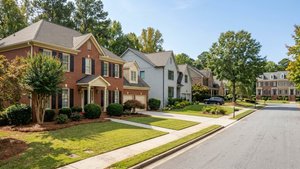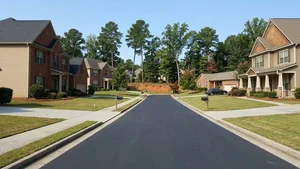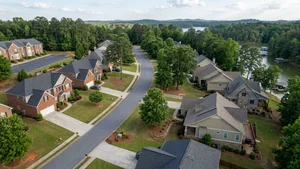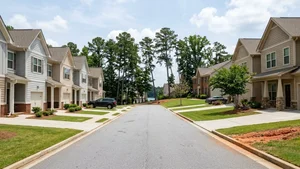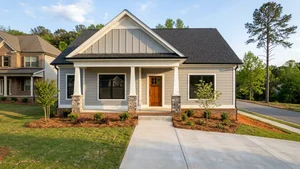
Lake Lanier's new construction market spans five Northeast Georgia counties, bringing a mix of massive planned communities, small custom subdivisions, and townhome infill. Buying new here means weighing builder premiums against what the resale market is doing, and right now that resale market gives you more room to negotiate than builders would prefer to admit.
A resale baseline lets you judge a builder's asking price and figure out where you have room to push back.
Key takeaway
A new single-family build around Lake Lanier gives you the stronger negotiating position. Single-family homes here take a median 92 days to sell, so builders are competing with a deep resale supply and you can ask for price cuts or closing credits. New townhomes are the cheaper way in, but they are a tighter market with less room to bargain.
Who this guide is for
You are shopping new construction near Lake Lanier and deciding whether a builder's price and incentives beat what the resale market would give you.
Market conditions for new builds around Lake Lanier
Around Lake Lanier, the resale market gives new-build buyers a strong advantage on single-family homes but little on townhomes. Single-family resales currently have 5.4 months of supply, take that median time to sell, and close at 97.9% of list. Townhouses run at 3.9 months of supply with 27.9% selling above list, based on a small sample of 26 recent sales.
For the bigger picture, see Lake Lanier Housing Market.
Single-family homes cost more per square foot than townhomes, but the townhome's lower total price buys less space, not a better rate. At that level of supply, sellers outnumber buyers enough that a builder's list price on a single-family home is an opening number. The market data covers all recent sales, new and resale together, and that combined inventory is the competition every builder is pricing against. You can review housing market trends to see the full picture of local supply and demand.
Where new homes are being built
The Lake Lanier shoreline touches five Northeast Georgia counties: Dawson, Forsyth, Gwinnett, Hall, and Lumpkin. Growth pressure continues across the region, and county-level zoning shapes almost everything about what gets built and where. Hall County's 2026 Unified Development Code update introduced new residential zoning districts covering detached single-family, townhome, and mixed-use development standards that govern how new subdivisions are approved.
In Forsyth County, residential building permit activity remains active in 2026 despite some zoning restrictions. The county's Board of Commissioners extended a broader residential rezoning moratorium through October 25, 2026, but created exceptions for certain districts. Peninsula parcels have continued to move through rezoning review, such as a recently recommended four-house development on Timber Lake Trail.
Buyers will typically encounter three kinds of new product: amenity-heavy planned lake communities, small custom-builder subdivisions on larger lots with no homeowner association, and in-town townhome infill. Confirm which county a lot sits in before you go much further, because it sets your school district, utility provider, and tax bill. Tax structures vary by county, so review Forsyth vs Hall or Dawsonville vs Cumming to see the differences.
Single-family homes versus townhomes
The median sale price for a single-family home in the Lake Lanier area is $439,815, up 7.4% year over year. The townhouse median sits at $302,994. The single-family market is rising in price but slow to close, which is where your advantage shows up: builder credits and favorable terms.
The townhouse market is smaller and moves closer to list. Based on that small sample of recent townhouse sales, expect less room on price and be ready to decide faster if you want one. A single quarter of sales can swing these numbers considerably.
Comparing a builder's quote to resale homes
Recent sales show single-family homes trading at a median of $188 per square foot, while townhouses sit at a lower median. If a builder quotes you $520,000 for a 2,400-square-foot new build, that works out to roughly $217 per square foot, about 15% above the single-family median.
A 1,600-square-foot townhome at the $185 per square foot townhouse median would be around $296,000, which illustrates that the townhome discount is mostly about size rather than a lower cost per square foot.
The overall median mixes waterfront and inland homes, old and new, so compare any quote against recent resales in the exact same community or immediately nearby. Ask the builder for recent closed prices in the community, not just current list prices. Then ask them to itemize the lot premium, structural options, and design upgrades that explain any price gap between their quote and the area median.
Builder incentives and room to negotiate
There are currently 212 single-family homes in inventory, and only 10.2% recently sold above list. With most resales closing under the asking price, a builder's rate buydown, closing-cost credit, or free upgrades is a realistic ask.
A finished spec home gives you fewer choices but moves faster and is more negotiable, especially if the builder wants it off their books before quarter's end. A to-be-built home gives you more choice but requires a longer wait, and the price is set at contract signing.
Get any closing-cost credit written directly into the contract. Compare the builder's preferred-lender incentive against at least one outside lender's quote before you decide it's a good deal. Get the builder warranty terms in writing, including the length, what's covered, and how claims work. Ask the HOA for current dues, what they cover, and any planned special assessments. If you need help gathering data, North Georgia Group can pull recent resale comparisons for a specific community.
Lake access, docks, and lot location
Lake Lanier is a federal reservoir, and the shoreline is managed by the U.S. Army Corps of Engineers. Because the land along the shoreline is federal, many lots marketed as lakefront stop short of the actual water. A new lot can sit near the water without qualifying for a private dock.
Request the plat or survey showing the Corps of Engineers boundary line for any lake-adjacent lot. Confirm private dock eligibility with the USACE Lanier Project Management Office before signing a contract. If the neighborhood offers shared access, ask whether a community slip or marina space is deeded, leased, or waitlisted. Check the utilities to confirm whether the lot is on public sewer or septic. Dock permit limits can rule out the lot you liked most, and it's better to know that before you're under contract.
How to narrow your options
If your budget sits closer to the townhouse median than the single-family median, read the single-family versus townhome breakdown first, then run your numbers through the price-per-square-foot example. If a private dock or true water frontage is a must, start with the lake access and dock rules before touring any community, because those federal limits can rule lots out immediately.
If you have a quote in hand, run it through the worked example to see how it compares to the area median, then use the incentives section to decide what to ask for. If you need to move by a fixed date, weigh how a finished spec home compares with a to-be-built home or a resale, because the timelines are genuinely different.
Lake Lanier housing market at a glance
All homes, Lake Lanier (90 days ending 2026-09-30): median sale price $394,447, -0.1% year over year; 153 homes sold; median 89 days on market; 97.8% sale-to-list; 12.6% sold above list; 5.3 months of supply; 266 homes in inventory
Single-family, Lake Lanier (90 days ending 2026-09-30): median sale price $439,815, +7.4% year over year; 120 homes sold
Single-family, Lake Lanier (90 days ending 2026-09-30): median 92 days on market; 97.9% sale-to-list; 10.2% sold above list
Single-family, Lake Lanier (90 days ending 2026-09-30): 5.4 months of supply; 212 homes in inventory; $188 median price per sq ft
Townhouse, Lake Lanier (90 days ending 2026-09-30, based on only 26 sales, so read with caution): median sale price $302,994, -0.7% year over year; median 88 days on market; 98.6% sale-to-list; 27.9% sold above list
Townhouse, Lake Lanier (90 days ending 2026-09-30, based on 26 sales): 3.9 months of supply; 33 homes in inventory; $185 median price per sq ft
Source note: Redfin data via market data pull. Figures include resale and new construction together and are not new-construction-only.
New home developments on Lake Lanier FAQs
What county are new Lake Lanier developments in?
The shoreline spans Dawson, Forsyth, Gwinnett, Hall, and Lumpkin counties, meaning taxes and services differ drastically depending on where you build. Verify the parcel's zoning and school assignment through the county assessor before signing a contract.
Is Lake Lanier in Buford or Gainesville?
It borders both cities, plus addresses in the Cumming, Flowery Branch, Oakwood, and Dawsonville areas. A new build's mailing address does not tell you its county. You can compare Buford vs Flowery Branch to see how municipal services differ across the lake.
How low does Lake Lanier get, and does it matter for a lakefront lot?
Yes, it matters, because during drawdowns a shallow cove can leave a dock sitting on mud. Full pool is 1,071 feet above mean sea level, but the record low hit approximately 1,050.79 feet in December 2007. Ask for the water depth at the exact dock site at the winter pool target of 1,070 feet.
Is Lake Lanier open to the public?
Yes. A new community's lake access shares the water with public ramps and parks, so private access means a private dock or slip, not exclusive water. Most fee parks charge $3.00 per pedestrian or $8.00 per vehicle, while some like Little Ridge and Belton Bridge are free.
Are there 55+ new home communities near Lake Lanier?
Yes, age-restricted new construction exists nearby. You can review 55+ and retirement communities to see current options and restrictions.
Do new homes near Lake Lanier have HOA fees?
Fee structures vary by development type. While planned communities mandate monthly dues, small custom subdivisions often operate without an association. Request a full fee schedule during due diligence to confirm if boat slips, landscaping, or private roads require separate assessments.