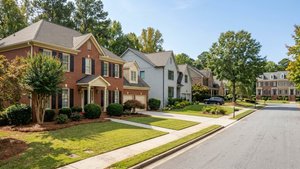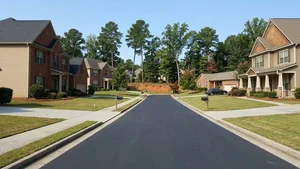
Investing in Alpharetta, GA real estate means buying into a market where conditions shift depending on the type of home you choose. With 368 homes for sale across the city, buyers have options, but the financial math looks very different for a detached house than it does for a condo.
Deciding what to buy requires looking past the citywide averages to see how specific segments are performing. The right choice comes down to your budget, your timeline, and whether you plan to lease the property out.
Key takeaway
If you are buying an investment property in Alpharetta now, start with townhouses. Prices fell 8.5% over the past year and they have more unsold supply than any other home type, so sellers are negotiating. The catch is that townhouses still cost more per square foot than detached homes, so if a fast, easy resale matters more to you than the purchase price, look at single-family homes, which sell quickest.
Who this guide is for
You are weighing whether to buy a rental or hold property in Alpharetta and deciding which type of home to put your money into.
Is Alpharetta a good place to invest in real estate?
The citywide picture is flat: all-home prices saw 0% change year over year, and there are currently 5.2 months of supply. Appreciation isn't doing the work right now, so your return depends almost entirely on the price you pay and the rent you collect. Within that flat market, townhouses are the one segment where buying at a genuine discount is a realistic plan.
A roughly balanced market means room to negotiate, but that room is uneven by property type. Townhouses cost more per square foot than single-family homes that sell in a median 37 days. That makes a townhouse a negotiation play that only works if you buy below list, single-family homes the resale-speed play, and condos an entry-cost play with the weakest exit.
The GA-400 employer base provides a steady stream of housing demand, which you can read more about on the job market page. If you're looking for neighborhood-level detail, that information lives on the best-neighborhoods page.
How to narrow your options
Does the deal have to work on rent alone, with no help from appreciation? Prices are flat citywide, so go to the worked example in the numbers section before you shortlist anything.
How quickly might you need to sell? If you may need to exit within a few years, read the single-family homes section. If you can hold through a slow resale, the townhouse and condo sections open up.
How much cash can you put in, and will the HOA let you rent? A lower entry price points to condos, but read the HOA leasing rules first, because a leasing cap can rule a building out entirely.
Are you planning nightly or weekly rentals rather than a 12-month lease? Read the short-term rental rules section before you price any property on short-term income.
If you want the most room to negotiate on price, start with townhouses. The easiest resale points to single-family homes. The lowest purchase price and down payment point to condos, after you've checked HOA leasing rules.
Alpharetta investment properties by type
Alpharetta's 368 active listings are unevenly distributed across property types, and that distribution forces a real trade-off between your entry price, your negotiating room, and how quickly the home sells when it's time to exit. Current market conditions dictate which strategy works best for each segment, and those conditions aren't the same across the board.
Matching the property to your investment goals means understanding how each type performs: townhouses offer the most negotiating room, single-family homes sell fastest, and condos carry the lowest entry price but the slowest exit.
Townhouses offer the most room to negotiate
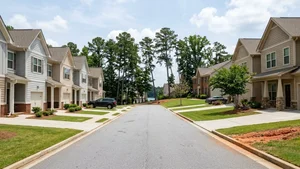
Townhouses currently have 7.5 months of supply, the most of any type in the city. Sellers are waiting on buyers, which means you can realistically ask for price cuts, closing-cost help, or repairs. This is the one segment where buying below list is a plan rather than a wish.
Even after the price drop, Alpharetta townhouses cost more per square foot than detached single-family homes. They sit at a median $269 per square foot, a few dollars more per foot than detached homes; see the at-a-glance list for details. Most townhouse communities also carry an HOA, which bears on leasing and operating costs.
The discount is on the sticker price, not on space. You're still paying more per square foot than for a detached house, so a townhouse only makes sense as an investment if you negotiate the price down. Buying at list gives up the whole reason to choose one.
Single-family homes sell the fastest
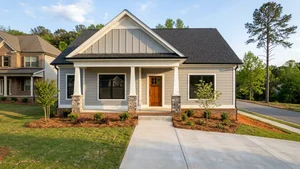
Detached homes in Alpharetta went under contract in a median 37 days, faster than townhouses or condos. Close to one in five sold above list, which shows sustained buyer interest in this segment. If you may need to sell in a few years, this is where a resale is least likely to sit.
Because they move quickly, buyers have less room to ask for concessions. Expect to pay closer to the asking price. Sellers hold the edge here, so you're also looking at the highest entry price of any type and the least negotiating room. On a lease, rent covers the smallest share of what you paid, so this property type leans more on long-term value than on monthly cash flow.
Condos have the lowest entry price
The Alpharetta condo median is about half the citywide median for all homes. Based on just 23 condo sales, the median sale price was $384,960, which means a smaller down payment for an investor. Don't treat the 16% year-over-year rise shown in the at-a-glance list as a trend given that sample of 23 condo sales.
The overall price is lower, but condos carry the highest price per square foot of any property type in the city. You get less space for your money, and you'll need to factor in monthly association dues.
Then there's the exit problem. Condos are the slowest type to resell, at a median 78 days, and the fewest sell above list. Building rules can also cap how many units are rented, so a cheap entry can become a hard exit. Check the HOA's leasing rules before you make an offer.
Running the numbers on an Alpharetta rental
Because all-home prices saw zero percent growth over the past year, the math on the specific property decides the deal. Broad assumptions won't get you far here.
This is general information, so confirm all figures with a lender and a tax professional before making a purchase.
Calculating returns on a median-priced townhouse rental
Townhouse supply is high, so consider a clearly labeled hypothetical: an accepted offer at 95% of a $615,007 asking price is about $584,250, roughly $30,750 less. This is for illustration only, not a prediction of what a seller will accept.
Applying the 1% rule to the median price implies you'd need about $6,150 a month in rent for the property to pass that threshold. Compare that figure with leased comparables for the same unit type and size, and with the area rent benchmark in the FAQ section below.
When expected rent falls short of that rule, the deal leans on long-term value and tax treatment rather than monthly cash flow. Rules of thumb ignore HOA dues, taxes, insurance, vacancy, and repairs. Passing or failing the 1% test is only a first filter. Build a full expense sheet with real quotes before you decide anything.
Property taxes on a rental home
Georgia taxes property on 40% of its fair market value. The bill applies the city millage rate plus Fulton County and school millage rates to that assessed value. You can read more about local levies on the cost of living page.
A rental property can't claim the homestead exemption the seller may have had, because that exemption applies only to a primary residence. For the same townhouse in the worked example, the 40% assessment would be multiplied by the combined 2026 millage rates for the city, county, and schools.
Here's the practical catch: the tax bill on the listing usually reflects the seller's exemptions, not yours. Ask for the seller's latest tax bill and recalculate it without the homestead exemption before you settle on an offer price.
HOA leasing rules and dues
Townhouse and condo HOAs in Georgia can restrict leasing through their governing documents. These restrictions often include caps on rented units, minimum lease terms, waitlists, and bans on short stays.
Before you go under contract, ask for the declaration, bylaws, current dues, any special assessments, and the current rental count. You should also check the utilities page to see whether the property uses city water and sewer or a well and septic system, because that changes operating costs.
A leasing cap can mean you can't rent the unit you bought until a slot opens. That turns an investment into a carrying cost, and you won't learn about a rental waitlist from the listing.
Short-term rental rules in Alpharetta
The City of Alpharetta requires every short-term rental to obtain an annual license and a separate occupational tax certificate. Owners must also collect and remit the city's 8% hotel-motel excise tax on a monthly basis.
The ordinance limits short-term rentals to no more than 5% of homes in any one neighborhood, restricts licenses to single-family housing units, and requires a designated local contact person reachable at all times. Owners must submit a sworn affidavit that the use is not prohibited by the subdivision's covenants. Confirm short-term rental permit and tax requirements with the city before counting on nightly income.
Short-term income only counts if both the city and the HOA allow it. Price the property on a standard 12-month lease first and treat any short-term income as upside.
Alpharetta housing market outlook for investors
There were 368 homes for sale against 218 sold recently across the city. Supply is ahead of sales, which favors patient buyers willing to negotiate.
Watch whether townhouse supply keeps building or starts to clear, since that decides how long the negotiating window stays open. You can review the full trend picture on the housing market page, and check the job market page to understand local demand. If school assignment factors into your tenant demand, verify any address with the Fulton County Schools address lookup and review the schools page for more detail.
How to get started
Talk to a lender about investment-property terms, which differ from owner-occupied loans in their rate and reserve requirements. Most down payment assistance programs require you to live in the home, which you can read about on the homebuyer programs page.
Confirm on the county assessor site that the parcel is inside Alpharetta city limits, because an Alpharetta mailing address doesn't guarantee it. Pull leased comparables for the same unit type and size from the past six to twelve months rather than relying on area averages.
If you'd like help pulling leased comparables or HOA documents for a specific property, the North Georgia Group can help. You can also review our guide on questions to ask a realtor to prepare for your search.
At a glance
All homes: median sale price $749,643, 0% change year over year, 218 homes sold (90 days ending 2026-09-30)
All homes: 50 median days on market, 98.4% sale-to-list, 15.4% sold above list (90 days ending 2026-09-30)
All homes: 5.2 months of supply, 368 homes for sale, $266 median price per square foot (90 days ending 2026-09-30)
Single-family homes: median sale price $854,659, up 1.8% year over year, 137 sold, 37 median days on market (90 days ending 2026-09-30)
Single-family homes: 4.1 months of supply, 184 for sale, 98.6% sale-to-list, 17.8% sold above list, $263 median price per square foot (90 days ending 2026-09-30)
Townhouses: median sale price $615,007, down 8.5% year over year, 57 sold, 60 median days on market (90 days ending 2026-09-30)
Townhouses: 7.5 months of supply, 140 for sale, 98.2% sale-to-list, 12.5% sold above list, $269 median price per square foot (90 days ending 2026-09-30)
Condos (based on only 23 condo sales, so read with caution): median sale price $384,960, up 16% year over year, 78 median days on market, 5.6 months of supply, 43 for sale, 97.2% sale-to-list, 4.3% sold above list, $275 median price per square foot (90 days ending 2026-09-30)
Alpharetta real estate investing FAQs
How much are houses in Alpharetta, GA?
The median sale price for all homes in Alpharetta is about $749,643, while detached single-family homes sit at a median of $854,659. These figures cover the 90 days ending September 30, 2026. If you're looking for lower entry points, check the property type section above for townhouse and condo pricing.
How much is rent in Alpharetta, GA?
According to the U.S. Census Bureau's 2020-2024 American Community Survey 5-year estimates, the median gross rent in Alpharetta city is $1,948 per month. For fiscal year 2026, HUD's Fair Market Rents for the area set a studio at $1,585 and a three-bedroom at $2,182. Because area figures are averages, you should pull leased comparables for the specific unit type you plan to buy.
Is Alpharetta, GA in Fulton County?
Yes, Alpharetta is a city located within Fulton County, Georgia, and carries the city's 8% hotel-motel tax rate. Some properties with an Alpharetta mailing address may fall outside city limits or in another county entirely, which changes the tax rate and municipal services. Confirm the parcel on the county assessor site before assuming it falls under city jurisdiction.
Is Alpharetta a buyer's or seller's market?
The city leans toward a balanced market overall, with most homes closing slightly under asking and only about one in seven going over list price. Across all homes, the sale-to-list ratio was 98.4%, with 15.4% sold above list during the 90 days ending September 30, 2026. Market conditions differ by property type, so review the type profiles for specific negotiating power.
What is the 2% rule for an investment property?
The rule suggests a property should generate monthly rent equal to at least two percent of its purchase price. On a median-priced Alpharetta townhouse, that means collecting about $12,300 a month in rent. Comparing that figure to the rent benchmarks in the previous question shows why this rule rarely fits higher-priced suburbs, making it a screening shortcut rather than a measure of return.
What is the 70% rule in flipping houses?
This rule states an investor should pay no more than 70% of the after-repair value minus repair costs. Single-family homes in Alpharetta recently saw a 98.6% sale-to-list ratio, meaning resales close very near their asking prices. Because homes sell for what they ask, your after-repair value should come from recent sold comparables rather than list prices, and you should get contractor bids before you calculate.