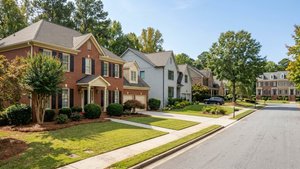
Buying a home in Alpharetta means planning for the yearly carrying costs, and property taxes are a major piece of that puzzle.
Key takeaway
Your Alpharetta property tax bill is set less by the rate than by the price you pay. Georgia taxes a share of market value, and a sale gives the assessor a fresh number, so the tax line on a listing is the seller's bill, not yours. If you want room to lower that base, townhouses are the place to push: prices are falling and they have the most supply of any home type. If you need a single-family home, budget from your own offer price and file for the homestead exemption.
Who this guide is for
You're weighing an offer on an Alpharetta home and need to know what the property tax bill will be once it's yours, not what the current owner pays.
How Alpharetta property taxes are calculated
The bill is fair market value times the assessment ratio, minus exemptions, times the total millage rate divided by 1,000. State law sets the ratio and local governments set the rates. That leaves two levers you control:
The value, through the price you pay and the evidence you bring to an appeal.
The exemptions you file.
Homestead protections then limit how fast taxable value can grow from that base.
Assessed value is 40% of fair market value
Under state law, taxable real property in Georgia is assessed at 40% of fair market value unless the law specifies otherwise. The State Revenue Commissioner reviews the ratio each year for uniform application among counties. Every $10,000 of price is $4,000 of taxable value before exemptions.
The ratio can't be negotiated or appealed; only the value and your exemptions can move. A recent sale is strong evidence of fair market value.
Millage rates from Fulton County, the city, and the schools
Inside city limits, three bodies levy tax: Fulton County, the City of Alpharetta, and Fulton County Schools. One mill equals $1 per $1,000 of assessed value.
Fulton County: a General Fund rate of 8.87 mills for the 2025 tax year.
City of Alpharetta: a total of 5.75 mills for its fiscal year 2026 budget (covering the 2025 tax digest), made up of 5.05 mills for operations and 0.70 mills for debt service.
Fulton County Schools: 17.080 mills for 2025, adopted by the Board of Education. This is the largest of the three levies.
Rates are adopted each summer, so a figure quoted online may be last year's. Check that each rate you use is for the current tax year.
Questions that change your tax estimate
If the home has an Alpharetta mailing address, first confirm it sits inside city limits; the jurisdiction section below shows how. The answer decides whether the city levy or Forsyth County rates apply.
If the home will be your primary residence on January 1, read the homestead exemption section and the homestead deadline FAQ. If it won't be, estimate your bill without any exemptions.
If the home is new construction or was finished during the year, read the new construction section before trusting any current tax statement.
If you're choosing between a single-family home, a townhouse, and a condo, the home-type section shows how the price gap and negotiating room change the bill.
Check which jurisdiction an Alpharetta address is in
A mailing address does not set the tax bill; the parcel's tax district on the county record does. Look up the parcel on the Fulton County or Forsyth County assessor site and read the tax district before estimating anything.
Homes inside Alpharetta city limits
These parcels carry the county, city, and school levies above, and the worked examples below assume this case. Parcels just outside the limits may skip the city levy but receive different services, so compare the full bill, not one line.
Alpharetta mailing addresses in Forsyth County
Alpharetta lies entirely within Fulton County. Homes northeast of the city that share the Alpharetta mailing address can sit in unincorporated Forsyth County. Those parcels pay unincorporated Forsyth County and Forsyth County Schools millage, and the city levy does not apply.
Listing sites often label these homes "Alpharetta," but that is a postal label, not a tax district. The county record is the reliable answer. The school district can differ too, so confirm it with the district's own address lookup, not the listing.
Milton, Johns Creek, and unincorporated Fulton addresses
Neighboring cities share ZIP codes with Alpharetta, and each sets its own city millage. Two similarly priced homes in the same ZIP code can therefore carry noticeably different bills, and a price comparison is incomplete without each parcel's tax record.
Estimated property taxes by home type in Alpharetta
The examples below apply that formula to current median prices. They are grouped by the trade-off you make: a higher base with little price room, a base you can negotiate down, or the lowest base on thin data.
Single-family homes
The single-family median sale price recently sat at $854,659, a taxable value of about $341,864 before any exemption. Apply the combined 2025 rates for the county, city, and schools for a baseline annual bill, then reduce it by filing for a homestead exemption.
This is the highest bill of the three types and the hardest to cut. With only 4.1 months of supply, sellers have less reason to lower the price that sets your base.
Townhouses
Townhouses give you the most room to negotiate. The median sale price is $615,007, down 8.5% year over year, which becomes $246,003 in assessed value. Townhouses also have the most supply of any home type in Alpharetta right now, at 7.5 months of inventory. A lower price negotiated against that inventory lowers your tax base for years to come.
HOA dues sit on top of the tax bill and aren't in this math. Ask the HOA for current dues and any planned special assessments before comparing a townhouse with a detached home.
Condos
Condos have the lowest likely bill in the city. The condo median sale price is $384,960, which translates to $153,984 in assessed value. This median rests on only 23 sales over a 90-day period, with a median of 78 days on the market. In a sample that small, one or two sales can move the median, so treat the figure as a rough guide.
Condo dues can offset the tax savings, so ask the association for current dues and what they cover.
Why the listing's tax figure isn't your tax bill
The tax amount on a listing is the seller's bill after their exemptions, not a quote for the next owner. When a property changes hands, the county reassesses its value and the previous owner's tax breaks disappear.
The seller's exemptions and freeze don't transfer
The listing's tax line reflects the current owner's homestead exemption, the capped value built up over years of ownership, and possibly a senior exemption. None of these follow the house to you, so a long-held home's bill can sit well below what a new owner will pay.
Note which exemptions the current owner has on the record and remove them from your estimate. Your first full-year bill can be much higher than the listing showed. Escrow set from the old figure can leave a shortage, so ask your lender to set escrow from your purchase price, not the seller's bill.
A lower purchase price lowers your tax base
Negotiating a better deal pays off twice. Taking 3% off the townhouse median removes about $18,450 from the price, which is $7,380 less in assessed value. Multiply that reduction by the total millage rate to get your annual savings. With a homestead exemption limiting growth, that saving can repeat every year you own the home.
A low price doesn't bind the assessor, who can still set a higher value. The long-run benefit also depends on filing for homestead and on which levies the cap covers.
New construction bills jump after the first year
Under Georgia law, each year's property tax return and assessment must reflect the property's condition and ownership as of January 1. A new home finished mid-year can show a tax bill for little more than the lot, then jump the following year when the completed structure is assessed.
Ask the seller or builder for the most recent tax bill and whether it reflects a full year of a finished home. If escrow is set from a lot-only bill, expect a shortage and a higher monthly payment in year two, so ask the lender for an estimate based on the full value.
Exemptions that lower Alpharetta property taxes
Exemptions lower the value that each levy is multiplied by, and you file for them after closing.
Homestead exemption and valuation freeze
The homestead exemption applies only if the home is your primary residence as of January 1 and you apply for it; it does not apply automatically. In Fulton County, it also caps how fast your assessed value can grow from the year you file, so the price you paid becomes the base.
House Bill 581 created a statewide floating homestead exemption, effective 2025, that caps the growth of a homestead's taxable value to the inflation rate. Local bodies handled it differently:
Fulton County: the Board of Commissioners opted in alongside the county's pre-existing 3% floating exemption, and the Board of Assessors applies whichever is more beneficial.
City of Alpharetta: the city has its own floating exemption and did not opt out, so homeowners receive whichever is more beneficial.
Fulton County Schools: opted out, so the HB 581 cap does not cover every levy on the bill.
Disabled veteran and other exemptions
For tax year 2025, the Georgia Department of Revenue states that a qualifying disabled veteran, or an unremarried surviving spouse, is granted a homestead exemption equal to the greater of $32,500 or the maximum amount allowed under federal law. That federally indexed amount is $121,812 for 2025. The same amount applies to the surviving spouse of a servicemember killed in or who died as a result of a war or armed conflict.
These exemptions require documentation, and some have eligibility rules you must prove when you apply. Check requirements with the Fulton County Board of Assessors before counting the savings.
How to look up, appeal, and pay your Alpharetta property tax bill
Fulton County handles assessments, appeals, and billing for homes inside Alpharetta city limits.
Look up a property's tax record
The Fulton County Board of Assessors' official property portal is at fultonassessor.org. Before you make an offer, search by address or parcel ID and read the tax district, the assessed value, the exemptions listed, and the last bill. The listed exemptions are the numbers to strip out when you estimate your own bill.
Appeal your assessment notice
Under state law, Fulton County property owners who disagree with their Annual Notice of Assessment have 45 days from the date on the notice to file an appeal with the Board of Assessors. If the Board makes no change, the appeal is automatically forwarded to the Board of Equalization.
A closing statement at a lower price, or recent comparable sales, is strong evidence. Buyers in a softer segment like townhouses may have the strongest case. A missed deadline locks in that year's value.
Pay your tax bill
The Fulton County Tax Commissioner's official bill lookup and online payment site is fultoncountytaxes.org. You can pay online, by mail, or in person. If you use an escrow account, your mortgage lender pays the bill on your behalf, but confirm the lender received it.
The first bill after closing may still be addressed to the seller, and an unpaid escrowed bill is still your bill. Check the Tax Commissioner site after the bills go out.
Alpharetta home prices at a glance
To see how these prices fit into broader trends, review the latest updates on the Alpharetta housing market.
All homes: median sale price $749,643, 0% change year over year, 218 homes sold (90 days ending 2026-09-30)
All homes: median price per square foot $266, sale-to-list 98.4%, 5.2 months of supply, 50 median days on market (90 days ending 2026-09-30)
Single-family: median sale price $854,659, up 1.8% year over year, 137 sold, 37 median days on market, 4.1 months of supply, 17.8% sold above list (90 days ending 2026-09-30)
Townhouses: median sale price $615,007, down 8.5% year over year, 57 sold, 60 median days on market, 7.5 months of supply, 98.2% sale-to-list, 140 on the market (90 days ending 2026-09-30)
Condos: median sale price $384,960, up 16% year over year, 78 median days on market, 5.6 months of supply, 97.2% sale-to-list. Based on only 23 condo sales, so treat it as a rough guide (90 days ending 2026-09-30)
If you need to pull and read a tax record for a home under consideration, the North Georgia Group can help you run the numbers.
Alpharetta property tax FAQs
Do people over 65 pay property taxes in Alpharetta?
Yes, unless they are fully exempt on a specific levy. For tax year 2026, Fulton County Schools offers senior homestead exemptions with no income limit. The reduction in assessed value is 25% at ages 65 to 69 and 50% at 70 and older, provided the homeowner held a basic homestead exemption for five of the last six years. Fulton County also offers income-based exemptions.
When are property taxes due in Alpharetta?
For the 2025 tax year, Fulton County bills outside the City of Atlanta were due in a single installment on October 15, 2025. The Tax Commissioner mails bills, generally in the summer. Due dates can shift, so confirm the date printed on your bill. Unpaid bills incur a late penalty.
How long do I have to file for homestead after buying in Alpharetta?
File with the Fulton County Board of Assessors by April 1 to apply for the current tax year; applications submitted later apply to the following tax year. You only need to file once as long as you continue to own and occupy the home as your primary residence on January 1.
Is Alpharetta cheaper than Atlanta for property taxes?
It depends on the home's value and the city levies. Atlanta Public Schools held its rate at 20.500 mills for FY2025 and proposed the same for FY2026, which is higher than the Fulton County Schools rate that applies in Alpharetta.
Why are property taxes in Alpharetta so high?
Bills scale with home values, and the median price per square foot across all Alpharetta homes is $266. Inside city limits, the county, city, and school levies also stack on one bill.
Do you pay property taxes at closing when you buy in Alpharetta?
Yes. The current year's taxes are typically prorated between the buyer and the seller on the settlement statement. Ask your closing attorney how the proration is handled and who pays the bill when it arrives later in the year.
Does the City of Alpharetta send its own property tax bill?
No. The Fulton County Tax Commissioner bills and collects city taxes on one consolidated bill, which you can look up and pay on the Tax Commissioner's site.