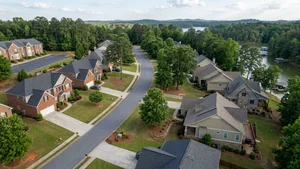
Lake Lanier covers a massive footprint across five Georgia counties, meaning your monthly housing costs depend entirely on which side of the water you choose. Buford Dam sits about 35 miles northeast of Atlanta, and the surrounding rental market splits into towns that cater to local workers and towns that function as commuter suburbs.
When you search for an apartment or rental house near the water, you won't find a single unified market. Addresses here use town names like Gainesville, Buford, and Cumming, each carrying its own pricing tier and its own commute times.
Key takeaway
The town and county you rent in dictate your monthly payment more than the lake itself. If keeping costs low is your priority, start your search in Hall County towns like Gainesville, which fall under a lower federal rent benchmark than the Atlanta-facing side of the water. If you're renting while saving to buy, townhouses offer a cheaper entry point, but single-family homes currently have more inventory and give buyers room to negotiate.
Who this guide is for
You're looking to rent near Lake Lanier and deciding which town fits your budget and commute, or whether renting still makes more financial sense than buying a townhouse or house.
What you can expect to pay for rent around Lake Lanier
There's no single baseline rent for Lake Lanier because the shoreline falls across two different federal benchmark areas. Rent is set town by town, with Hall County falling under the Gainesville metro area, while Forsyth, Dawson, and Gwinnett counties fall under the Atlanta metro umbrella. A search for lake apartments mostly returns complexes with Gainesville, Oakwood, Buford, and Cumming addresses, and the side of the lake you choose dictates how far your budget goes.
For 2026, HUD's Fair Market Rents for the Gainesville area (Hall County) are $1,381 for a one-bedroom, $1,514 for a two-bedroom, and $1,834 for a three-bedroom. On the Atlanta-metro side, those benchmarks jump to $1,660 for a one-bedroom, $1,820 for a two-bedroom, and $2,182 for a three-bedroom. These figures represent the 40th-percentile gross rent including utilities, not a simple average of asking rents.
The consequence is straightforward: the exact same housing budget buys a different number of bedrooms depending on which side of the lake you land on. Long-term residential leases price differently than nightly vacation rentals on the water. If you need a full monthly picture, compare these rent figures alongside other expenses on our cost of living page.
Deciding where to rent around the lake
Narrowing down your search comes down to your daily drive and your future plans. A few basic questions are worth answering before you tour anything:
Does your commute run toward Gainesville or toward Atlanta? Driving toward Gainesville points you to the Hall County side, while heading toward Atlanta on I-985 or GA 400 points you to Buford, Cumming, or Dawsonville.
Is your budget below the federal benchmark for the bedroom count you need on that side of the lake? If it falls short, check the other side's benchmark before you cross towns off your list.
Do you expect to buy within the next year or two? If so, weigh the current dynamics: townhouses are cheaper to enter but very competitive, while single-family homes cost more but offer room to negotiate.
Do you want to be on the water, or just near it? As the FAQ section explains, you don't need to pay a premium for a lakefront rental to use the public parks and beaches.
If you want the lowest benchmark rent and a commute toward Gainesville, start with Gainesville or Oakwood. They fall under the cheaper HUD rent area and have the most rental listings. If you want a shorter drive toward Atlanta on GA 400, start with Cumming, but compare its median gross rent against the Atlanta benchmark before committing.
If you want the cheapest path to ownership, start with townhouses, but budget for competition given how often they sell above list price. If you want room to negotiate when you buy, single-family homes are where that happens, with 5.4 months of supply giving buyers time on inspections, repairs, and terms.
Renting in Hall County
These towns sit under HUD's Gainesville benchmark, offering some of the lowest housing costs near the water. The main trade-off for those lower prices is a longer drive toward Atlanta via I-985, which makes this side of the lake a better fit for local workers or remote employees.
Gainesville
Most of the apartment complexes that appear in online searches for the lake carry Gainesville addresses, giving renters the most inventory to choose from. Hall County's median gross rent sits at $1,341, which tracks closely with the area's one-bedroom benchmark and reflects Gainesville's role as a major local employment center. The city is officially known as the Poultry Capital of the World, a title it earned after Jesse Jewell started what became a billion-dollar-a-year agricultural industry following World War II.
The trade-off is the distance. Gainesville is the farthest of these towns from Atlanta, so time the rush-hour drive from your specific address to your workplace before signing a lease.
Oakwood
Oakwood offers a smaller pool of rentals just south of Gainesville. Because it shares the Hall County rent benchmarks, prices here generally stay below Atlanta-metro averages.
One thing to check: if you're renting near the local college campus, ask the landlord whether leases follow the academic calendar and what happens if you need a 12-month term that starts mid-year.
Flowery Branch
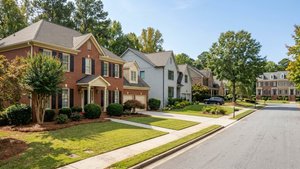
Flowery Branch sits directly on the I-985 corridor between Gainesville and Buford, making it a reasonable middle ground for commuters. Many of the rental properties here are detached houses in residential subdivisions rather than traditional apartment complexes.
If you rent a house in an HOA community, get the HOA's leasing rules in writing before you sign anything. Ask specifically about tenant registration requirements and which amenities tenants are allowed to use.
Renting closer to Atlanta
These towns sit under HUD's Atlanta-metro benchmark, putting them in a higher pricing tier than the Hall County side. The trade-off for that higher rent is closer access to Atlanta employers via I-985 and GA 400, which draws a large commuter population to this side of the water.
Buford
Buford is a major retail center, anchored by the Mall of Georgia at 3333 Buford Drive. The city spans both Gwinnett and Hall counties, so a "Buford" address alone doesn't tell you which local government services or school system the property uses. Gwinnett County's median gross rent is $1,810, which aligns with the higher Atlanta-metro pricing tier.
That county split is worth taking seriously. The county and school system depend on the exact street address, so confirm both with the official district lookup tool rather than assuming based on the town name.
Cumming
Cumming is the county seat and the only incorporated city in Forsyth County. Renters here face the highest costs in the immediate lake area, with Forsyth County showing a median gross rent of $2,090. In exchange, residents get direct access to the GA 400 corridor for commuting south.
The price you pay for that location is traffic. GA 400 is the main route toward Atlanta, and rush-hour congestion is a daily reality.
Dawsonville
Dawsonville sits at the northern end of the GA 400 corridor, known primarily as the home of the North Georgia Premium Outlets at 800 Highway 400 South. Rents here fall under the Atlanta-metro umbrella, but finding an available unit takes patience. It's a small town, so expect a short list of rentals, and check how many current listings match your budget before making it your primary focus.
When it makes sense to buy instead of rent
If your rent is climbing toward $1,800 a month, purchasing a home starts to look like a viable alternative. Based on 26 recent sales, the median price for a townhouse near the lake is about $302,994. Put 10% down ($30,299) and you're left with a loan of roughly $272,695. With 30-year fixed mortgage rates recently hovering between 6.7% and 7.03%, the monthly principal and interest on that loan often lands close to the two- and three-bedroom rental benchmarks for the area.
Taxes, insurance, and HOA dues will add to that monthly payment, so review our cost of living guide to build a complete budget. If you need help with the upfront costs, our homebuyer programs page covers down payment assistance options. The North Georgia Group can pull current townhouse and single-family comparable sales for the specific town you're renting in.
Buying a townhouse
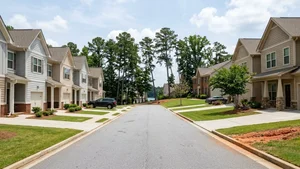
Townhouses offer the cheaper path to ownership. At $185 per square foot, they cost slightly less than detached houses on that measure. You save money because you're buying less space, not because the space itself is discounted.
The catch is competition. This segment of the market moves quickly, with 27.9% of recent townhouses selling above list price, so don't expect much room to negotiate on price. You'll also want to factor in association fees that a straight rent comparison tends to leave out. Ask the HOA for current dues and what they cover before you put a townhouse payment side by side with your rent.
Buying a single-family home
Single-family homes carry a much higher entry price, with a median sale price of $439,815. This is the side of the market where buyers have room to breathe, though. With 5.4 months of supply available, you have time to inspect properties carefully, ask for repairs or seller credits, and compare different homes without the same pressure you'd feel on the townhouse side.
The upfront cost is the real hurdle. Prices rose 7.4% year over year, meaning your negotiating power here applies to terms and timelines rather than price itself, and you'll need a larger down payment than a townhouse requires. You can track these ongoing shifts on our housing market page.
Lake Lanier real estate at a glance
Recent sales data shows that homes typically closed about 2% under their asking price. Here are the current figures for the area:
All homes: median sale price $394,447, down 0.1% year over year (153 sales, 90 days ending Sept. 30, 2026)
Single-family homes: median sale price $439,815, up 7.4% year over year (120 sales, 90 days ending Sept. 30, 2026)
Townhouses: median sale price $302,994, down 0.7% year over year (based on only 26 townhouse sales, 90 days ending Sept. 30, 2026)
Median days on market: 89 for all homes, 92 for single-family, 88 for townhouses (townhouse figure based on 26 sales; 90 days ending Sept. 30, 2026)
Sale-to-list ratio: 97.8% for all homes, 97.9% for single-family, 98.6% for townhouses (townhouse figure based on 26 sales; 90 days ending Sept. 30, 2026)
Share sold above list price: 12.6% of all homes, 10.2% of single-family, 27.9% of townhouses (townhouse figure based on 26 sales; 90 days ending Sept. 30, 2026)
Months of supply: 5.3 for all homes, 5.4 for single-family, 3.9 for townhouses (90 days ending Sept. 30, 2026)
Homes for sale: 266 total, 212 single-family, 33 townhouses (90 days ending Sept. 30, 2026)
Median price per square foot: $188 for all homes, $188 for single-family, $185 for townhouses (townhouse figure based on 26 sales; 90 days ending Sept. 30, 2026)
Lake Lanier rent FAQs
Where is Lake Lanier, Georgia, and what county is it in?
Lake Sidney Lanier is a USACE reservoir on the Chattahoochee River, with Buford Dam located about 35 miles northeast of Atlanta. Its shoreline touches five Georgia counties: Gwinnett, Forsyth, Hall, Dawson, and Lumpkin. Rental addresses around the water use town names like Gainesville, Buford, and Cumming rather than "Lake Lanier."
Is Lake Lanier a cheap place to rent in Georgia?
It depends on the county. Georgia's statewide median gross rent is $1,393, and Hall County comes in below that at $1,341. Gwinnett County ($1,810) and Forsyth County ($2,090) are more expensive than the state median.
Can I afford rent near Lake Lanier making $20 an hour?
Earning $20 an hour yields a gross annual income of $41,600, meaning 30% of your gross monthly income is about $1,040. That falls short of the one-bedroom federal rent benchmarks for both the Hall County and Atlanta-metro sides of the lake. Ask each landlord for their specific income requirements, as many require tenants to earn three times the monthly rent.
Can you live on $1,500 a month near Lake Lanier?
Rent alone will consume most or all of a $1,500 monthly budget, depending on which side of the lake you choose. The one-bedroom benchmarks for the area range from $1,381 to $1,660, leaving very little room for utilities, food, or transportation. Review our cost of living and utilities guides to build a realistic budget.
Is Lake Lanier free to use if you rent away from the water?
Yes, you don't need to rent a lakefront property to access the water. Per the current USACE fee schedule, most day-use parks charge $8.00 per vehicle, while pedestrians and bikes enter for $3.00. Frequent visitors can purchase a USACE Annual Pass for $40, which covers all day-use parks for the year.
Can you rent a house with a boat dock on Lake Lanier?
Yes, but private docks require a USACE shoreline use permit held by the adjacent property owner. These permits are governed by zoning allocations and are never granted in public recreation areas. If you find a rental with a dock, ask the landlord for the current permit and get written confirmation that tenants are allowed to use it.
How much is a security deposit on a rental near Lake Lanier?
For leases entered into or renewed on or after July 1, 2024, Georgia law caps security deposits at the equivalent of two months' rent. The funds must be deposited in an escrow account established only for that purpose, and the deposit must be returned within 30 days after the landlord regains possession of the unit. Confirm the deposit amount and the escrow account's location in your lease before signing.
Is rent going up around Lake Lanier?
Rent trends fluctuate based on the specific town and available inventory. If rent is flat or falling when you look, you have room to negotiate a renewal rate with your landlord. If prices are rising, asking to lock in a longer lease term may save you money over time.